

SEASON FIVE
Lethal Dissent: Iran’s hunt for its citizens abroad
On Spec’s 18-month investigation takes you inside the secret war waged on Iranian dissidents in exile. We follow poets, soldiers, politicians and ordinary folk who have escaped the Islamic Regime but still live in fear of being hunted down and forced back to Iran to be imprisoned or executed.
Lethal Dissent is produced in partnership with The World, with funding from the Pulitzer Center and Radio Zamaneh.
ATTENTION: If you are seeing a “Preview” badge in the podcast player, you can click on “On Spec Podcast” next to it to listen to the full episodes on Spotify.
SEASON FIVE’S GUEST HOST
Nafisa Haji
“Headline news—especially lately—feels like a constant bombardment of horror and shock, lacking context and nuance. Slow journalism fills this gap, giving us human stories we can relate to and which can inform us to the point of taking action for change.”
Nafisa Haji is an American author, born and raised in Los Angeles. She studied history at the University of California at Berkeley, taught elementary school in downtown Los Angeles, and earned a doctorate in education from the University of California at Los Angeles. She is the author of two novels, The Writing On My Forehead and The Sweetness of Tears, is currently working on a third, and lives in Bodrum, on the Aegean Coast of Turkey.

Take a deep dive into the episodes below

Fariba Nawa and Özge Sebzeci wrap up the season with some great news about some of the characters we met in Lethal Dissent.

In the final episode, Mohammad Shabani’s suicide note is analyzed by a handwriting expert and Fariba Nawa gets the results. She follows the ripple effects of the new information, and Mohammad’s best friend tries to make sense of what it means.

Fariba Nawa is threatened. She steers her reporting to focus on impunity. The investigation into Iran’s hunt for dissidents goes to the United Nations, inside a Turkish parliamentary hearing, and to the US State Department to find out if anyone will intervene.

The Sağlam family's kidnapping operation is caught in a police dragnet. The ensuing police investigation reveals an entire network of conspirators behind the Sağlams. When one conspirator is arrested and interrogated, he confesses. Fariba Nawa uses the confession to tell the story of Iran's behind-the-scenes involvement.

Rezaie gets into the car with the Sağlams. But he already knew he was being tricked. His suspicions had begun long before he climbed into the car, back at the kebab restaurant when the Sağlams introduced him to an American woman. Fariba Nawa tries to untangle the story of the American woman, and finds out how Rezaie foiled the kidnapping plot against him.

There’s a convincing explanation for Mohammad Shabani’s death, but the evidence is incomplete. While Fariba Nawa waits for a crucial piece of evidence to be analyzed, she tries to find out how far Iran will go to silence dissidents. A Turkish court case exposes an Iranian kidnapping ring and offers an answer. Fariba finds a source to guide her through some of the inner workings of the secret operation.

In the city where the dissident Mohammad Shabani died, Fariba Nawa finds evidence that points towards his cause of death.

The death of poet Mohammad Shabani, an Iranian dissident living in Turkey, catches his friends, family, and supporters by surprise. Fariba Nawa finds one of Mohammad Shabani’s confidantes and learns new details about his life in exile before he died.

When two close friends who work for the Iranian government follow their conscience, it puts them at odds with the regime. Now one of them is dead. To figure out what might have happened, reporter Fariba Nawa goes back to the beginning.

Reporter Fariba Nawa introduces her investigation into Iranian plots against exiles in Turkey. She tells the story of Iran’s history of violence against its citizens at home, and how that violence has grown to cross international borders today. The fate of a dissident in France becomes a blueprint for the questions she seeks to answer.
Behind the Scenes & Interviews
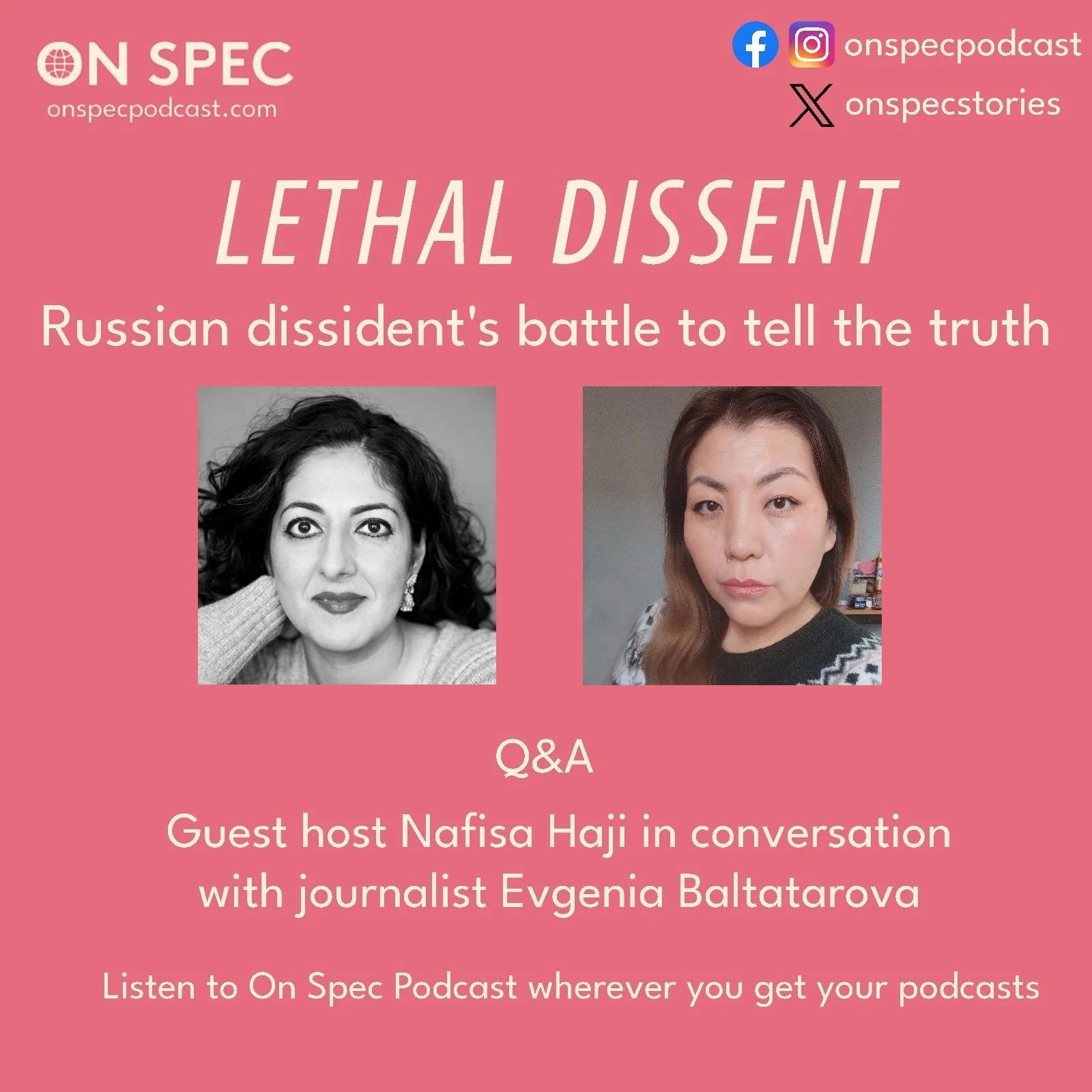
Guest Nafisa Haji interviews Evgenia Baltatarova, a journalist and activist from Siberia, who fled Russia for Kazakhstan soon after the start of the war in Ukraine, when authorities ensnared her in a crackdown on critics of the war. Baltatarova had to move countries once again when Russia sought to have her extradited from Kazakhstan, and talks about the toll exile takes on one’s life.

Guest Nafisa Haji interviews Emile Dirks, Research Associate and China expert at Citizen Lab, about Beijing’s tactics for silencing critics abroad, and the controversy over TikTok.

Guest host Nafisa Haji interviews independent journalist and analyst Borzou Daragahi about what it was like covering the killing of Jamal Khashoggi, and what the case says about the growing problem of impunity and transnational repression.

Iranian protesters thought they were about to topple the regime during the Woman, Life, Freedom movement, but once again the regime crushed the demonstrations despite some wins for women. Journalist Samira Mohyeddin talks about the weaknesses and strengths of the movement and why it’s not over. She also gets personal about navigating identity and journalism.
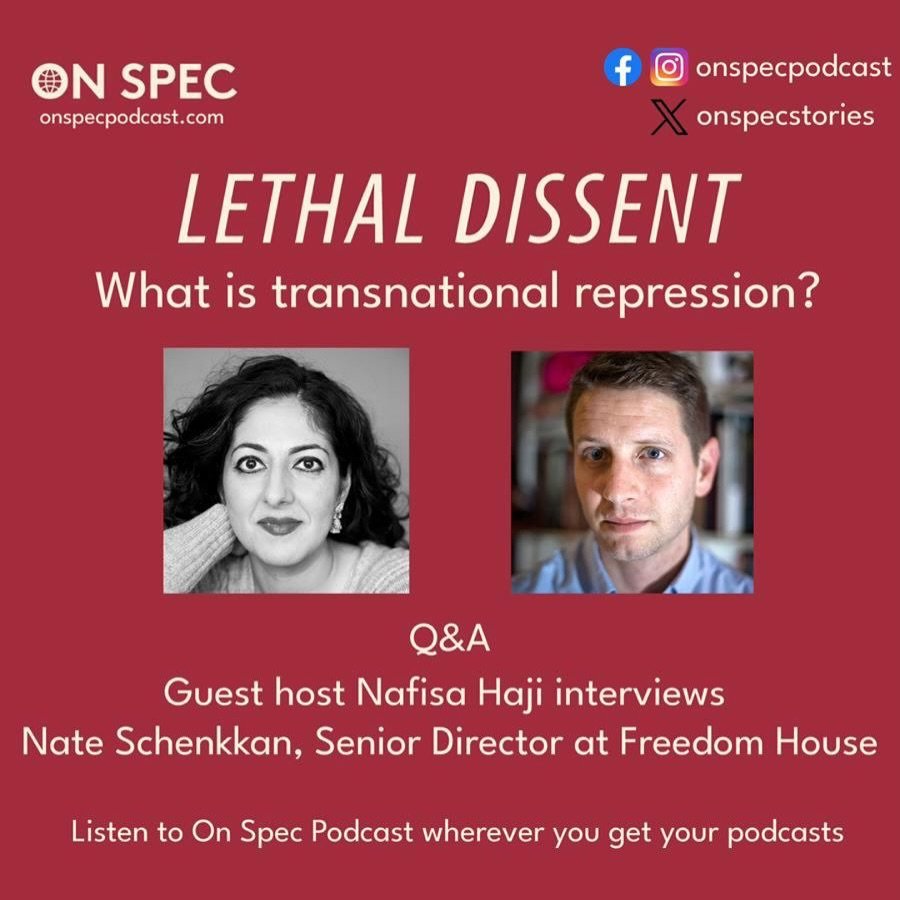
Host Nafisa Haji speaks with Nate Schenkkan, Senior Director of Research at Freedom House, about Transnational Repression. The term is familiar in policy circles and academics but what’s the meaning behind these two words? Who’s accountable for protecting dissidents targeted beyond their own borders by their own countries, and how is policy shaped in a global setting when sometimes countries are both protector and perpetrator?

Guest host Nafisa Haji interviews reporter Fariba Nawa about the adventures of reporting Lethal Dissent for two years, getting threats and the feedback the show received from listeners.
Season Five Contributors

John Klopotowski is a freelance journalist and translator based in Northern California and is currently interning for The World. He speaks Arabic and Turkish. John has recently enjoyed reporting on local politics and current events in Oakland, CA—some of this coverage can be read in Oaklandside. He spends his free time wrapping grape leaves and walking his Old English Sheepdog, Augie.

Uzair Ahmed, a Berklee College of Music graduate from Pakistan, elevates storytelling with the power of sound and music. A skilled audio engineer and producer, Uzair brings his global influences and a genre-infusing approach to projects across different mediums.

Hatiye Garip is an illustrator, comic artist and designer based in Istanbul, Turkey. She likes to draw birds, flowers and ordinary moments. Her works have been exhibited and published in many countries, including Portugal, Belgium, Lithuania, Bulgaria, the Czech Republic, South Korea, the USA and UK. She was one of the Adobe Creative Residency Community Fund 2020 recipients in last December. She has recently completed her first picture book Making My Own Way, which focuses on her childhood memories with her grandmother. Hatiye illustrated our third and fourth seasons, and the art for our website. You can see her works at hatiyegarip.com.

Ibby Caputo is a journalist based in the United Kingdom. She was the Senior Editor of “Overheard” at National Geographic for the first three seasons. She has worked as a story editor for The World and West Virginia Public Broadcasting and for several podcasts including “The Breakthrough” from ProPublica, and “Seeking Peace” from the Georgetown Institute for Women, Peace and Security.

Chris Harland-Dunaway is a senior producer at The World. He splits his time between chasing interviews for the daily edition of the show and working on longform audio projects like, “Lethal Dissent.” Before joining The World, he was a freelance reporter and producer. He’s produced extensively for Reveal and written investigative features for The Verge. He’s a graduate of the UC Berkeley Graduate School of Journalism where he concentrated on investigative reporting and audio. Outside of journalism, Chris loves riding and racing his road bike.

Beril Eski is an investigative journalist based in Istanbul. Her work focuses on immigration, government accountability and gender across Turkey. She has written for The Washington Post, The New York Times and more. With over a decade of reporting, she was part of a team with the New York Times that won the Pulitzer Prize for international reporting in 2024. She has also received the Overseas Press Club Award of America, The New York Times Publisher’s award and the Polk Awards with other investigative colleagues. Native in Turkish and fluent in English, she is still working on Arabic.
Nafisa Haji is an American novelist of Indo-Pakistani descent, acclaimed for her explorations of identity, displacement, and cultural heritage. Born in Los Angeles, she spent parts of her childhood in Karachi, Manila, Chicago, and London, experiences that deeply inform her storytelling. Her debut novel, The Writing on My Forehead, was a finalist for the Northern California Independent Booksellers Association Book of the Year Award. Her second novel, The Sweetness of Tears, continues her examination of personal and political boundaries. With a background in American history and education from UC Berkeley and UCLA, and experience teaching in bilingual classrooms, Haji brings a nuanced perspective to her work. She resides in Northern California with her family and maintains close ties to Pakistan.

Born next to the Bosphorus, Özge Sebzeci is a documentary and portrait photographer based between Turkey and Germany focusing on stories about gender, migration and ecology. Her approach revolves around establishing trust and intimacy with the people she photographs. She is deeply committed to diverse perspectives in visual storytelling. Sebzeci is a grantee with the National Geographic Society and Magnum Foundation. Her work has been published in National Geographic, Time, Die Zeit, NPR, The Atlantic, NRC Handelsblad, De Standaard, Horizonte, VG, and 140journos among others. She is a member of Women Photograph and Diversify Photo and Varız Buradayız.
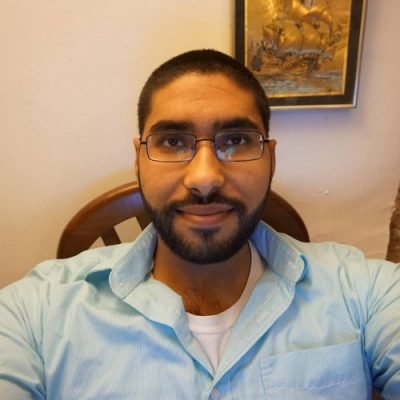
A physicist turned journalist, Umar’s reporting includes breaking news and investigative features, spanning four continents. He is a recipient of grants from the Pulitzer Center for Crisis Reporting and the National Geographic Society. He has been a correspondent for The Los Angeles Times, Reuters, and Al Jazeera English, reporting from the Middle East and South Asia, and a national investigative reporter with ProPublica. His work has also appeared in Foreign Affairs, Foreign Policy, the Atlantic, the Nation, the Intercept, National Geographic, the Wall Street Journal, and the Christian Science Monitor. Born in Pakistan and raised in New Orleans, he is fluent in Urdu and can do pretty well in Arabic and Turkish.

Fariba Nawa has been covering global news for 25 years from places like Afghanistan, Egypt, Iran, Pakistan and now Turkey. She is also a speaker and author of the book Opium Nation: Child Brides, Drug Lords and One Woman’s Journey through Afghanistan. A native Afghan, Fariba’s fluent in Farsi/Dari and can get by in Arabic and Turkish. Some recent work can be found in The World, Time, The Christian Science Monitor, The New Yorker, and The Financial Times.